Senior Operations Manager · Companies House

Operations leadership,
with AI delivered properly.

I run high-volume operations at the UK company register, a core data source for UK business onboarding checks. I deliver AI into operations the way regulated firms need it: scoped, measured, explainable, and signed off by a person.

£120krecurring annual saving delivered
2 departmentsunder my operational leadership
3 AI projectsscoped, evaluated and running on private infrastructure

Experience

Operations at national scale, where accuracy, auditability and service levels are not optional.

Senior Operations Manager

Companies House

  • Lead operational teams across two departments of the UK's register of companies.
  • Delivered a recurring saving of £120k a year.
  • Own day-to-day performance: throughput, quality, service levels and people.
  • Work with the register that underpins business verification and onboarding across UK banking and fintech.

Where I fit in fintech

  • Onboarding and KYB operations
  • Operations transformation
  • AI adoption in operations
  • Capacity and service-level management

How I deliver AI

I don't write code. I lead delivery: I set the specification and the acceptance tests, AI coding agents build to them, and I own the evaluation and the go-live decision.

  1. meScope

    Start from an operational problem with a measurable outcome. Define "done" before any build starts.

  2. AI agentsBuild

    Coding agents build to the specification in small, reviewable steps.

  3. meEvaluate

    Held-out tests, controls and documented failure cases. No metric, no launch.

  4. meGovern

    Deterministic logic for numbers, AI for explanation, and a person on every decision.

AI delivery

Three systems I scoped and evaluated, running on infrastructure I operate. No customer or personal data involved.

Decision support · human in the loop

OpsLab: AI agents recommend, a manager decides

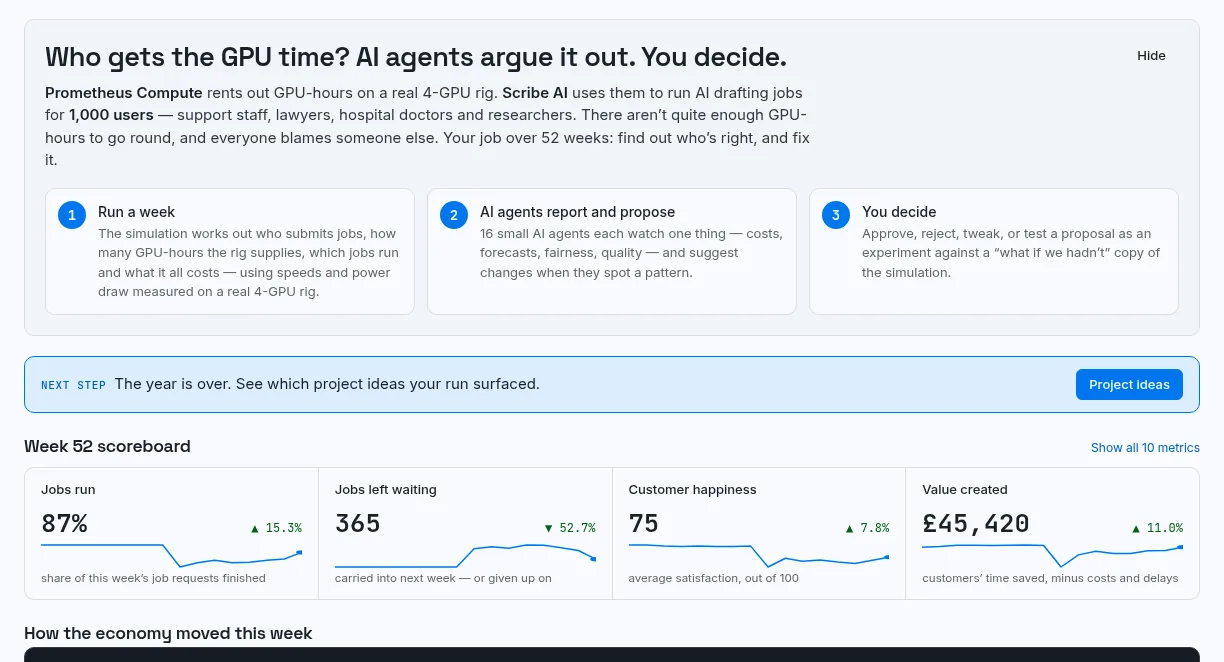
A simulation of an operation short of capacity, with competing customer groups and service targets. Sixteen narrow agents each monitor one risk (cost, fairness, quality, security) and propose changes. The manager approves, rejects, or runs a proposal as a controlled experiment against an unchanged control copy.

  • Every figure is calculated by deterministic rules. The language model only explains them, so every number is auditable.
  • Capacity calibrated from real benchmarks: 638 GPU-hours a week against roughly 10% more demand.
OpsLab dashboard showing a week-52 scoreboard: jobs run, jobs waiting, customer satisfaction and value created.
Private AI infrastructure

On-premises AI, run like a service

A four-GPU server running a 27-billion-parameter open model. Prompts and outputs never leave the building, and there is no third-party AI provider in the loop.

Incident: one card faulted repeatedly under load. Root cause found in the kernel logs, mitigated by capping the card's power and clocks, then verified with zero faults under sustained load.

  • Model27B open, local
  • Data leaving sitenone
  • Run withmonitoring, alerts, backups
Model cost reduction

Smaller models, same accuracy

A large "teacher" model trained a "student" about 16 times smaller. Smaller models cost less to run, answer faster and fit on cheaper hardware. Results were measured on held-out tests the student never saw in training.

195/200student on maths, level with the teacher

0.80 vs 0.50specialist student vs teacher, domain test
Let's talk.

Open to operations leadership roles in fintech, where running the operation and deploying AI are one job.